



Search for Articles
Special Issue Education Information Sciences Psychology and Education Sociology
Development of Gamified VR Content to Enhance Indoor Disaster Preparedness and Risk Perception
Journal Of Digital Life.2026, 6,S2;
Received:November 21, 2025 Revised:July 22, 2026 Accepted:October 13, 2026 Published:October 30, 2026

- Masaya Nakahara
- Faculty of Information Science and Arts, Osaka Electro-Communication University
- Yoshinori Tsukada
- Faculty of Engineering, Reitaku University
- Yoshimasa Umehara
- Faculty of Business Administration, Setsunan University
- Yutaka Tada
- Graduate School of Science and Engineering, Ehime University
- Yasunori Kozuki
- Center for Environmental and Disaster Resilience, Tokushima University
- Yukari Ando
- Graduate School of Disaster Resilience and Governance, University of Hyogo
- Tomoaki Tsuji
- Faculty of Information Science and Arts, Osaka Electro-Communication University
- Yuchi Kato
- Graduate School of Information Science and Arts, Osaka Electro-Communication University
Correspondence: nakahara@osakac.ac.jp
Abstract
In Japan, natural disasters such as earthquakes and floods are frequent. However, many citizens view such disasters as impersonal events rather than imminent personal threats. This has led to low participation rates in local disaster drills and poor retention of disaster prevention knowledge, posing significant challenges. Against this backdrop, existing research has reported the effectiveness of disaster prevention education utilizing gamification and VR. However, when applying existing approaches to VR-based disaster prevention education, it is necessary to consider the potential psychological burden of highly realistic depictions, opportunities for self-directed hazard identification, and replay-oriented design. Therefore, this study developed VR disaster prevention learning content incorporating gamification. The content was designed to foster a sense of crisis about disasters and interest in replay while considering psychological burden. The proposed content employs a "spot-the-difference" game mechanic, requiring users to actively identify deficiencies in indoor disaster preparedness measures. As a proof of concept, a questionnaire survey was conducted immediately after the experience with 123 participants, including high school students. Many participants reported an increased sense of crisis regarding disasters and an intention to replay the game.
1. Introduction
Japan is a country where natural disasters such as earthquakes and floods occur frequently compared to other nations worldwide. The 2024 Noto Peninsula Earthquake caused extensive damage, reaffirming the critical importance of disaster preparedness. However, according to a nationwide survey conducted in Japan the same year as the 2024 Noto Peninsula Earthquake, while over 70% of the population expressed anxiety about disasters, only about 20% had implemented specific disaster safety measures (National Federation of Workers and Consumers Kyosai Cooperatives, 2024). This gap between “awareness” and “action” is also reflected in the low participation rates in disaster drills conducted by local governments and other entities. Many individuals fail to personalize disaster risks, viewing them as remote occurrences. As a result, voluntary learning and daily preparations to mitigate damage are insufficient. To address this challenge, it is necessary to establish a system where each citizen repeatedly and voluntarily learns disaster prevention knowledge.
Against this backdrop, gamification—the application of game elements to boost motivation—is gaining attention. In particular, 3-D VR simulation has been used for disaster training (Farra et al., 2013), whereas disaster education using gamification has been reviewed without limiting the review to VR (Bai et al., 2024). Furthermore, the use of VR (Virtual Reality) is advancing as a means to solidify memory through experience. Because VR can provide a high level of immersion, it can offer realistic disaster-training experiences and complement conventional or tabletop exercises (Alshowair et al., 2024). VR-based studies have also examined protective actions and evacuation behavior during earthquakes (Li et al., 2017; Mitsuhara, 2024).
Numerous existing initiatives utilizing VR for disaster prevention education have been reported, including emergency response training during disasters, education on disaster prevention and mitigation during peacetime, and education on preventing occupational accidents.
VR-based disaster response drills incorporate initiatives that enable participants to experience decision-making during evacuation and route selection (CAD Center Co., Ltd., 2022; City of Sendai, 2024; Alpha Code Inc., 2023; Naka et al., 2017; Nakamoto et al., 2017; NOHMI BOSAI LTD., 2021; Shiga University Institute for Economic and Business Research, 2022; Shimbo et al., 2022; Tanioka et al., 2022). Many of these initiatives faithfully reproduce the topography of specific areas. By allowing participants to train in their own neighborhoods, they promote understanding of the risks and encourage recognition of disasters as something that could happen to them personally. VR-based initiatives focusing on disaster prevention and mitigation education during peacetime visualize damage based on the presence or absence of safety measures (Nakamoto et al., 2017). This approach aims to acquire the knowledge and safety measures necessary for disaster prevention and mitigation by understanding pre-disaster preparedness measures. VR-based initiatives for occupational accident prevention education promote learning appropriate actions during an incident by showing footage of an occupational accident occurring within a VR space that replicates the work site (CinemaRay Co., Ltd., 2022; Cybernet Systems Co., Ltd., 2019; Spacely, Inc., 2025). This initiative aims to prevent workplace accidents by ensuring thorough understanding of typical risks—such as being caught, entangled, or falling—and implementing preemptive safety measures.
Table 1 compares representative prior approaches with the proposed content in terms of target behavior, learning mode, psychological burden, and repetition mechanism. When applying these existing VR initiatives to the present study, three design considerations arise. The first is that using VR to enhance immersion during disaster response training may cause psychological burdens such as anxiety or distress in some participants; prior work has evaluated anxiety during immersive VR earthquake training (Rajabi et al., 2022). The second is to provide participants with an opportunity to identify hazardous locations independently, rather than relying primarily on video viewing in peacetime disaster prevention and mitigation education. The third is to make the content easier to replay by varying the problem presentation.
For the first design consideration, the content teaches disaster preparedness for peacetime while illustrating potential events that could occur during a disaster at locations with inadequate preparedness measures. This approach aims to foster a sense of urgency and promote learning about safety measures through visual and textual explanations, rather than evoking fear of disasters. For the second design consideration, the content creates a game where participants explore and select areas with inadequate disaster safety measures. This was intended to provide an opportunity for participants to scan the VR space and focus their attention on areas requiring caution in their surroundings. For the third design consideration, the content introduces game mechanics in which problems randomly switch to support replay-oriented engagement.
Therefore, this study develops gamified VR content focused on disaster preparedness during peacetime. Specifically, it introduces gameplay that identifies deficiencies in indoor disaster safety measures through a “spot-the-difference” format and illustrates the details of these deficiencies. The novelty of this study lies not in a fundamentally new VR technology, but in combining peacetime indoor preparedness, self-directed hazard identification, and a replay-oriented randomized problem structure.
Table 1. Comparison of Prior Approaches and the Proposed Content
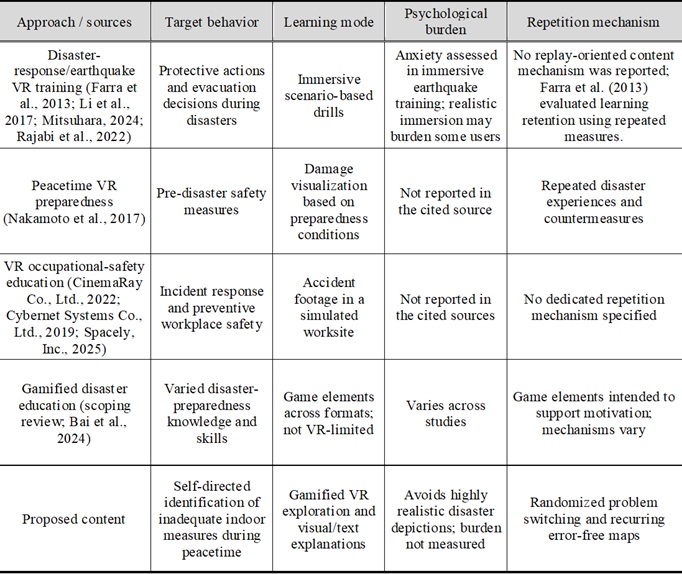
Note: “Not reported in the cited source(s)” refers only to the information described in the cited material.
2. Methods
This section describes the proposed content, equipment and implementation, game functions, experimental procedure and participants, questionnaire, and statistical analysis based on the design considerations presented in the previous section.
2.1 Overview of Methodology
This study develops VR content utilizing gamification to learn essential knowledge for disaster prevention and mitigation that should be addressed during peacetime, building upon the design considerations discussed in the previous section. This content is created with reference to the game “The Exit 8” (KOTAKE CREATE, 2023). “The Exit 8” is a 3D spot-the-difference game created by Kotake Create, where players must find strange phenomena called anomalies. The game’s mechanism allows players to escape by repeatedly navigating the same corridor and identifying discrepancies. This study adapts this concept by replacing the “anomalies” found in “The Exit 8” with hazardous indoor conditions lacking disaster safety measures. The goal is to develop VR content that enables even those with limited disaster knowledge to voluntarily identify potential hazards in their homes during peacetime.
The content was designed to provide participants with repeated opportunities to identify randomly appearing areas with insufficient disaster prevention and mitigation measures. Furthermore, since merely pointing out issues does not teach how to improve them, unlike “The Exit 8,” we have implemented game over conditions based on time limits or incorrect answer counts. When a correct answer is given or the game ends, the reason for the deficiency in disaster safety measures is displayed.
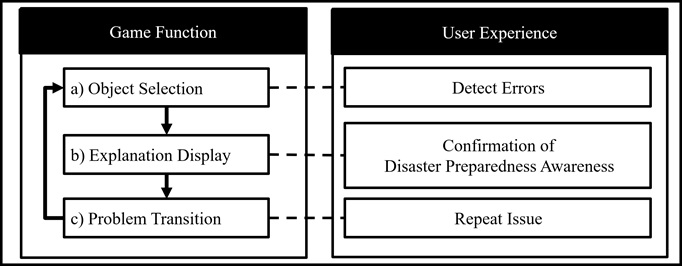
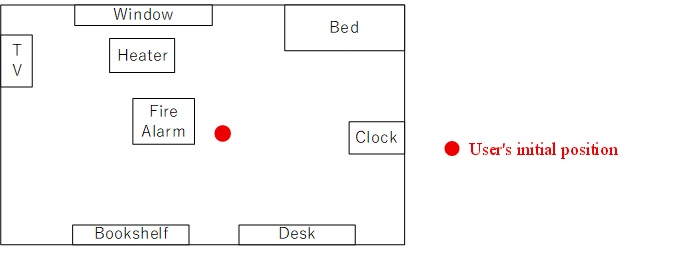
The processing flow for the proposed content is shown in Figure 1. The proposed content consists of an object selection function, an explanation display function, and a problem transition function. The floor plan of the created room is shown in Figure 2. The red dot indicates the player’s initial position. By looking around from this location, the player can identify areas with insufficient disaster safety measures. Furniture has been equipped with disaster safety measures; for example, the bookshelf has been fitted with tension rods to enhance safety. Furthermore, this content provides two types of VR spaces: one where one area with insufficient disaster safety measures is randomly placed on each map, and another where no errors are intentionally placed. The error-free maps were prepared to enhance the game experience and improve observational skills. The next map is selected at random from the unanswered questions, while error-free maps may appear multiple times.
2.2 Equipment and Implementation
The content was implemented using Unreal Engine 5.3. All participants at the three venues used a Meta Quest 3 headset and Touch Plus controllers with inside-out tracking and experienced the content while seated. Participants could move within the room using the left analog stick and rotate their viewpoint using the right analog stick. Although analog-stick locomotion was implemented, the explorable area was limited to a single room. The target frame rate was 60 fps, although actual frame-rate performance was not logged for individual sessions. An in-game tutorial was provided before the task.
2.3 Object Selection
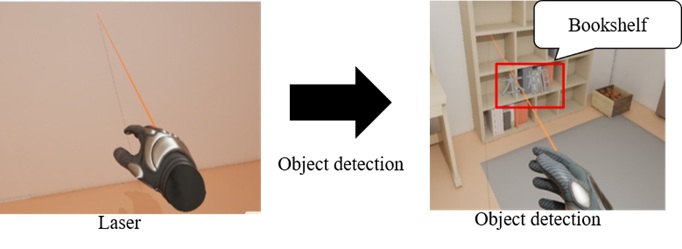
In this function, the participant identifies areas with inadequate disaster safety measures. First, a laser is emitted from the controller held in the participant’s right hand to select the object they wish to point out. Next, when the laser hits the object, the name of the selected object is displayed above the right hand (Figure 3). Then, if the controller’s trigger is pulled while the laser is active, the system determines whether the error detection was correct. However, if the participant judges that there are no areas with insufficient disaster safety measures, they are instructed to select a clock placed within the VR space. This function enables participants to think, explore, and point out issues themselves and was intended to provide an opportunity for self-directed hazard identification.
2.4 Explanation Display
This feature displays explanations of disaster prevention knowledge related to the pointed-out location when the participant selects the correct answer using the object selection function. First, if the participant correctly identifies an error, an explanation is provided detailing why the disaster safety measure is inadequate. At this point, the
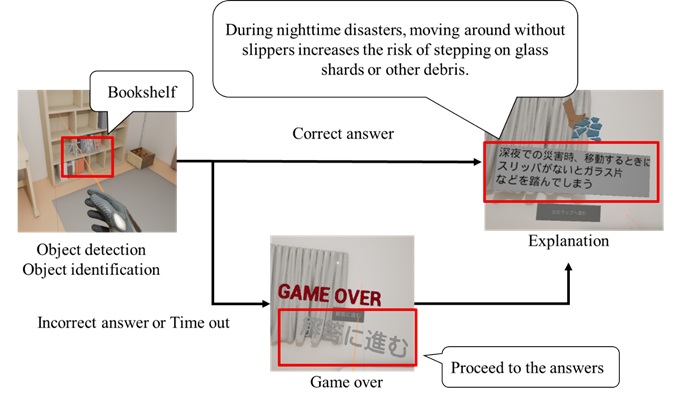
explanation is displayed alongside an illustration to facilitate the participant’s understanding and prevent accidental skipping. Conversely, if the participant incorrectly identifies an issue, it is counted as an incorrect answer. The system clearly indicates the error to the participant and prompts them to re-examine the area. If the number of incorrect answers exceeds a set limit, or if the pre-set time limit is exceeded, the game ends (Figure 4). At this point, an explanation is displayed for the area on the map where disaster safety measures were insufficient, aiming to improve the participant’s disaster prevention knowledge. Furthermore, to ensure understanding of the explanation, the in-game time limit is paused during the display of the explanation, and the selection of other objects is disabled to prevent a game over. This feature was designed to present the reasons for insufficient disaster safety measures during peacetime using illustrations of events that could occur during a disaster, while avoiding highly realistic disaster depictions.
2.5 Problem Transition
This feature randomly advances to the next question after displaying the disaster prevention knowledge explanation. First, when the participant points out an error and answers correctly, an explanation and a button to proceed to the next question are displayed (Figure 5). Next, when the participant selects the button, they move to the next map. The map they move to randomly selects an unanswered question from a pre-prepared set of questions. This content also includes error-free maps. By making these appear randomly multiple times, unlike other questions, it aims to enhance attention and observation skills. This introduces a game-like element with randomly switching questions and was intended to maintain interest in replay.
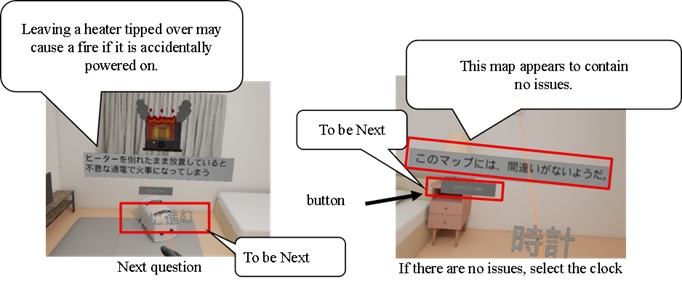
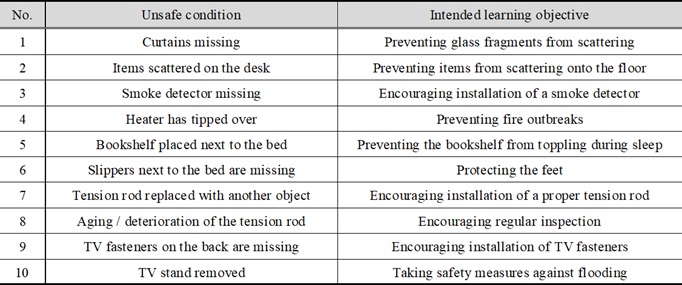
Table 2. Disaster Safety Measures Appearing within Proposed Content
2.6 Experimental Procedure and Participants
After informed consent was obtained, participants completed the in-game tutorial and experienced the proposed content once. During the task, they were asked to identify unsafe conditions embedded in the VR game corresponding to the 10 items shown in Table 2. The goal was to correctly identify all 10 items within a 3-minute in-game time limit, with up to seven incorrect answers permitted. The actual time required to complete the experience was not recorded, and whether or how often staff provided additional assistance with operation was also not recorded. The 10 items were developed by referencing the Disaster Prevention Specialist Textbook (Japan Bousaisi Organization, 2022) and Tokyo Disaster Prevention (Tokyo Metropolitan Government, 2023). They comprised fire safety measures (Items 3 and 4), furniture tipping and scattered-object safety measures (Items 1, 2, 5, 7, 8, and 9), and physical protection during evacuation (Items 6 and 10).
The survey participants comprised a total of 123 individuals who visited the three venues displaying the proposed content. At the first venue, 29 high school students from Osaka Prefecture participated (Group 1). At the second venue, 64 visitors to the National Disaster Prevention Promotion Convention held at Toki Messe Niigata Convention Center participated (Group 2). At the third venue, 30 visitors to the exhibition hall of the Japan Virtual Reality Society in Ibaraki City, Osaka Prefecture, participated (Group 3). These descriptions indicate the recruitment and implementation venues and do not represent measured characteristics of participants’ individual interests or experience. Gender, age distribution, prior VR experience, gaming experience, prior disaster education, and prior disaster experience were not collected, because the survey was required to be anonymous under the approved ethics protocol and the host organizations of the venues requested that personal attributes not be collected from visitors.
Table 3. Survey Questions

2.7 Questionnaire and Statistical Analysis
A paper-based questionnaire was administered immediately after the experience. The authors developed the four items in Table 3 to capture participants’ current sense of crisis regarding disasters (Q1), self-evaluation of disaster preparedness (Q2), perceived increase in their sense of crisis after the experience (Q3), and immediate intention to replay (Q4). In addition, cross-tabulations of Q1 and Q3 and of Q2 and Q4 were created to descriptively examine whether participants’ current sense of crisis and self-evaluated preparedness were associated with their perceived increase in sense of crisis and their intention to replay, respectively. Q1, Q3, and Q4 used a five-point scale from “Strongly agree” to “Strongly disagree,” whereas Q2 used a five-point scale from “Sufficiently prepared” to “Not prepared at all.” The items were neither validated nor piloted. The design of Q1 and Q2 was informed by the awareness–preparedness gap described in the nationwide survey cited in Section 1, whereas Q3 and Q4 were constructed to assess the immediate self-reported outcomes targeted in this study: perceived increase in sense of crisis and replay intention. The questionnaire did not directly measure knowledge acquisition or retention, actual behavioral change, usability, psychological burden, self-directed hazard identification, actual replay, or VR sickness.
Spearman’s rank correlation coefficient was used to examine monotonic associations among Q1-Q4 (Spearman, 1904). To examine differences in response distributions among recruitment groups, the Kruskal-Wallis test (Kruskal & Wallis, 1952) was conducted, followed by multiple comparisons using Dunn’s test with Bonferroni correction when differences were detected (Dunn, 1964). Two-sided p values below .05 were considered statistically significant. Correlation coefficients were interpreted as associations and not as evidence of causality. Because all items were answered at a single time point after the experience, the analysis was limited to describing monotonic associations; no regression model was fitted, because the data contain no temporal ordering among the items that would allow coefficients to be interpreted as relative or causal effects.
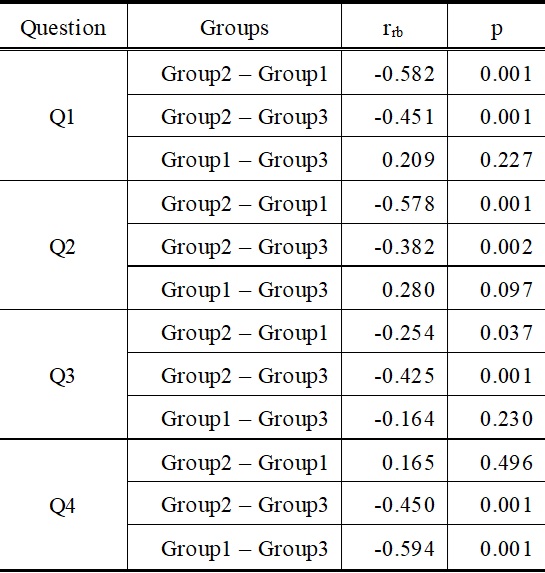
Rank-biserial correlation (rrb) was used as the effect size for pairwise comparisons (Kerby, 2014). It ranges from -1 to 1; the sign indicates the direction of the difference based on the order of the groups shown in the table, and the absolute value indicates the magnitude of the difference.
3. Results
3.1 Proof-of-Concept Experiment
Figure 6 shows the survey results for Questions 1 through 4. For Q1, 83% of respondents selected “Strongly agree” or “Agree.” For Q2, 47% selected “Sufficiently prepared” or “Moderately prepared.” For Q3, 83% selected “Strongly agree” or “Agree,” indicating that many participants reported a perceived increase in their sense of crisis regarding disasters immediately after the experience. For Q4, 87% selected “Strongly agree” or “Agree,” indicating that many participants reported an immediate intention to replay the game.
Figure 7 shows the response distributions by recruitment group. In Group 1, positive responses to Q2 were less frequent than in the other groups, whereas positive responses to Q4 were more frequent. In Group 2, positive responses to Q1-Q3 were more frequent than in Group 1, whereas no similar difference was observed for Q4. In Group 3, positive responses to Q3 and Q4 were less frequent than in the other groups.
3.2 Cross-Tabulation and Statistical Results
Figure 8 shows the cross-tabulation of Q1 and Q3. Many participants selected “Strongly agree” or “Agree” for both Q1 and Q3. However, some participants selected “Disagree” or “Strongly disagree” for Q3. Figure 9 shows the cross-tabulation of Q2 and Q4. Many participants selected positive responses for both Q2 and Q4. However, a small number of participants who selected “Moderately prepared” or “Minimally prepared” for Q2 selected “Disagree” or “Strongly disagree” for Q4.
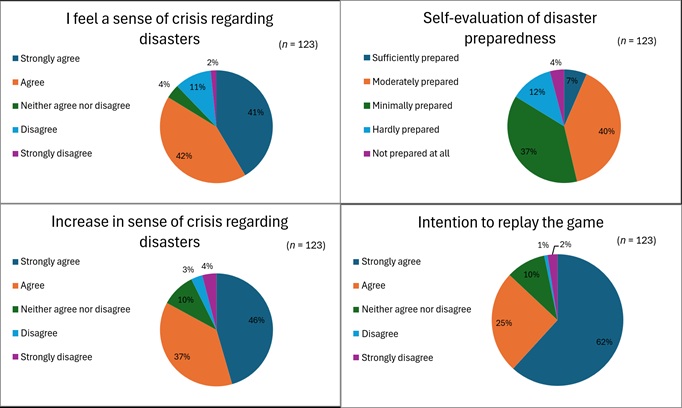
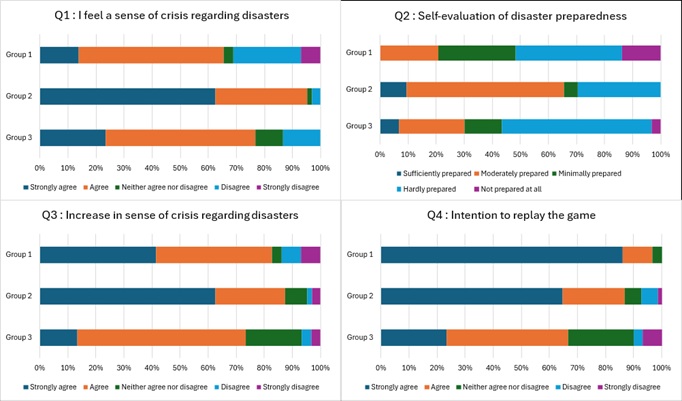
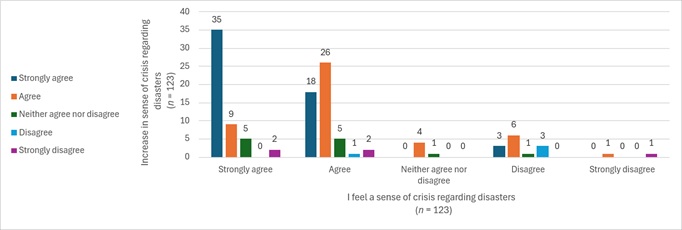
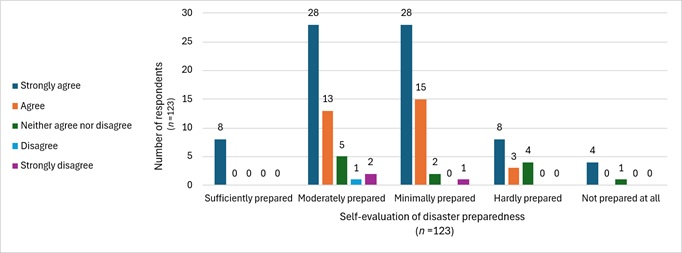
Table 4. Results of Spearman’s rank correlation coefficient
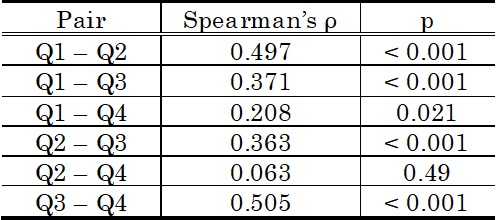
Table 4 shows the results of calculating Spearman’s rank correlation coefficients for responses to Q1 through Q4. Spearman’s ρ was 0.497 (p < 0.001) between Q1 and Q2 and 0.505 (p < 0.001) between Q3 and Q4, indicating moderate positive correlations in both cases. The coefficient between Q1 and Q4 was positive but weak (ρ = 0.208, p = 0.021), whereas the coefficient between Q2 and Q4 was close to zero (ρ = 0.063, p = 0.49).
The results of the Kruskal-Wallis tests are shown in Table 5, and the results of multiple comparisons using Dunn’s test are shown in Table 6. The Kruskal-Wallis test statistics were H = 29.44 for Q1, H = 25.79 for Q2, H = 14.34 for Q3, and H = 24.79 for Q4; significant differences among the three recruitment groups were found for all items (all p < 0.001). Dunn’s test identified significant differences between Group 2 and Group 1 and between Group 2 and Group 3 for Q1-Q3. For Q4, significant differences were found between Group 2 and Group 3 and between Group 1 and Group 3.
In the post-experience free-text responses, some participants commented that the explanations of why the identified conditions were problematic and the consequences those conditions could cause were insufficient. Others commented that the controls were difficult to understand because they did not usually play games. During the experience, some participants continued to select hazardous locations without checking the UI displayed on the left hand and reached game over within a short period.
4. Discussion
4.1 Discussion of Questionnaire Results
Figure 6 shows a gap between the responses to Q1 and Q2: many participants reported a sense of crisis regarding disasters, whereas fewer than half positively evaluated their routine disaster preparedness. This tendency was similar to the results of the nationwide survey mentioned in Section 1 (National Federation of Workers and Consumers Kyosai Cooperatives, 2024). Psychological distance may be related to this gap; however, its causes were not measured in the present survey. Furthermore, because Q1 and Q2 were both answered after the experience, they do not represent participants’ pre-experience states.
For Q3, 83% of respondents selected “Strongly agree” or “Agree,” and for Q4, 87% selected “Strongly agree” or “Agree.” These results represent participants’ immediate self-reports after the experience. They do not demonstrate that the content reduced psychological burden, increased actual replay, or produced repeated learning or long-term knowledge retention. Figure 7 also shows different response tendencies among the three recruitment groups. However, because the implementation environment, operating conditions, participant composition, and staff support were not recorded at the participant level, the differences cannot be attributed to a specific venue or participant characteristic.
4.2 Discussion of Cross-Tabulations
To examine the association between participants’ current sense of crisis regarding disasters (Q1) and their perceived increase in that sense after the experience (Q3), cross-tabulation was performed. The results are shown in Figure 8. Many participants selected “Strongly agree” or “Agree” for both Q1 and Q3. However, because Q1 and Q3 were both answered after the experience, these responses do not indicate a pre-post change. The content may have provided an opportunity to reconsider disaster risks in their immediate surroundings, but not all participants perceived a similar increase in their sense of crisis.
Next, to examine the association between self-evaluated disaster preparedness (Q2) and immediate intention to replay (Q4), the cross-tabulation results are shown in Figure 9. Many participants selected positive responses for both Q2 and Q4, whereas others selected negative responses. This co-occurrence does not show that the game promoted actual repeated learning or prevented the forgetting of disaster preparedness knowledge. Based on the free-text responses presented in Section 3, the control methods should be made more intuitive for participants with limited gaming experience.
Table 5. Results of the Kruskal-Wallis Test
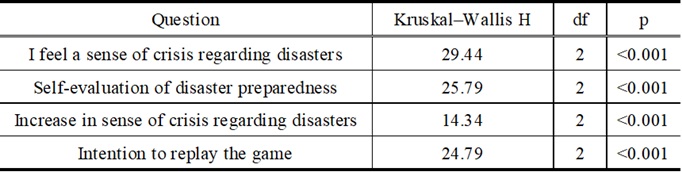
Table 6. Results of Dunn’s Test
4.3 Discussion of Statistical Analyses
The moderate positive association between Q3 and Q4 (ρ = 0.505) indicates that participants who reported a larger perceived increase in their sense of crisis also tended to report a stronger immediate intention to replay. The association between Q1 and Q4 was statistically significant but weak (ρ = 0.208, p = 0.021), and that between Q2 and Q4 was negligible (ρ = 0.063, p = 0.489). Because all four items were answered at the same time point after the experience, these coefficients describe co-occurrence within a single post-experience measurement. They do not establish causality, temporal precedence, or the relative influence of Q1 and Q3 on Q4. Estimating relative effects would require matched pre- and post-experience measures and an appropriate regression model, which is left to future work.
Next, differences in questionnaire results among recruitment groups were examined using the Kruskal-Wallis test and Dunn’s post-hoc test. The response distributions for Q1-Q4 differed among the groups. Because the same headset and controllers were used at all three venues, differences in presentation hardware can be excluded as an explanation. However, these differences describe group-level response distributions and do not demonstrate the effects of individual factors such as venue-level conditions or participant characteristics. The operational observations reported in Section 3 cannot be identified as the cause of the group differences, although they suggest that the UI and instructions should be made easier to understand.
4.4 Considerations for Future Work
First, regarding game operability, improvements are needed, such as enabling more intuitive controls, designing a user-friendly interface even for those inexperienced with games, and incorporating explanatory text. The UI should also be displayed in front of participants, and the tutorial should include an opportunity to practice basic controls before the game. Second, because the content was limited to a single room and a finite set of problem patterns, the spatial range of exploration was restricted, and repeated play could allow participants to memorize the patterns. Therefore, future versions should expand the content to multi-room residential environments, such as single-family homes and apartment units, and allow participants to search for hazards while moving between rooms. Future studies should use matched pre- and post-experience measures and directly assess psychological burden (including fear, anxiety, discomfort, and cybersickness), self-directed hazard identification, actual replay, and delayed knowledge retention. Future studies should also collect participant attributes such as age, prior VR and gaming experience, and prior disaster education under an ethics protocol and venue conditions that permit their collection, and examine how these attributes relate to differences among groups. Two additional questionnaire items will also be introduced: “Did playing this content make you want to try the disaster prevention measures introduced within it?” and “After playing this content, do you want to learn about disaster prevention through other content?” These items will assess participants’ immediate intention to implement disaster-preparedness measures and motivation to learn through other content. Because prior disaster experience was not collected, the possibility that the content evoked distressing memories in participants with such experience could not be examined. Future studies should include pre-screening and direct measures of psychological burden.
5. Conclusions
This study developed VR content using gamification to support learning about disaster prevention and mitigation measures that should be implemented before a disaster occurs. A questionnaire survey was administered immediately after the experience to 123 participants. Many participants reported an increased sense of crisis regarding disasters and an immediate intention to replay the game, and Spearman’s rank correlation analysis showed a moderate positive association between these two items. These findings are limited to immediate post-experience self-reports and replay intention. The study did not directly assess self-directed hazard identification, knowledge acquisition or retention, actual replay, behavioral change, psychological burden, or long-term repeated learning. Future work will improve operability, expand the range of explorable environments, and directly evaluate the outcomes not measured in this study.
Author Contributions
Conceptualization, M.N. and T.T.; methodology, M.N., T.T. and Y.K.; software, T.T.; validation, M.N., T.T. and Y.Kato; formal analysis, Y.T.; investigation, Y.U.; resources, Y.Tada, Y.Kozuki, and Y.A.; data curation, M.N.; writing—original draft preparation, T.T.; writing—review and editing, M.N., Y.Tsukada, Y.U., Y.Tada, Y.Kozuki, Y.A. and Y.Kato; visualization, T.T. and Y.Kato; supervision, M.N., Y.Tsukada and Y.U.; project administration, M.N.
Funding
This research was conducted with funding from a commissioned study by the National Institute of Information and Communications Technology (Grant No. 23603) and JSPS KAKENHI Grant Number JP26K01183. We express our gratitude here.
Institutional Review Board Statement
This research was reviewed and approved by the Bioethics Committee of Osaka Electro-Communication University and the Faculty Ethics Committee of Reitaku University.
Informed Consent Statement
Participants were informed that the survey results might be used for academic presentations and publications, and consent was obtained prior to participation.
References:
Alpha Code Inc. (2023). Retrieved November 13, 2025, from https://www.alphacode.co.jp/case/tokyo-bousai
Alshowair, A., Bail, J., AlSuwailem, F., Mostafa, A., & Abdel-Azeem, A. (2024). Use of virtual reality exercises in disaster preparedness training: A scoping review. SAGE Open Medicine, 12, 20503121241241936. https://doi.org/10.1177/20503121241241936
Bai, S., Zeng, H., Zhong, Q., Shen, Y., Cao, L., & He, M. (2024). Application of gamification teaching in disaster education: Scoping review. JMIR Serious Games, 12, e64939. https://doi.org/10.2196/64939
CAD Center Co., Ltd. (2022). Retrieved November 13, 2025, from https://www.cadcenter.co.jp/article/useful-article/bousaivr
CinemaRay Co., Ltd. (2022). Retrieved November 13, 2025, from https://www.cinemaray.co.jp/safety-education/
City of Sendai. (2024). Retrieved November 13, 2025, from https://www.city.sendai.jp/gensaisuishin/sendaisaigaivr.html
Cybernet Systems Co., Ltd. (2019). Retrieved November 13, 2025, from https://www.cybernet.co.jp/ar-vr/products/
Dunn, O. J. (1964). Multiple comparisons using rank sums. Technometrics, 6(3), 241–252. https://doi.org/10.1080/00401706.1964.10490181
Farra, S., Miller, E., Timm, N., & Schafer, J. (2013). Improved training for disasters using 3-D virtual reality simulation. Western Journal of Nursing Research, 35(5), 655–671. https://doi.org/10.1177/0193945912471735
Japan Bousaisi Organization. (2022). Bousaisi textbook. Japan Bousaisi Organization.
Kerby, D. S. (2014). The simple difference formula: An approach to teaching nonparametric correlation. Comprehensive Psychology, 3, 11.IT.3.1.
KOTAKE CREATE. (2023). The Exit 8. PLAYISM. Retrieved November 13, 2025, from https://playism.com/ja/game/the-exit-8/
Kruskal, W. H., & Wallis, W. A. (1952). Use of ranks in one-criterion variance analysis. Journal of the American Statistical Association, 47(260), 583–621. https://doi.org/10.1080/01621459.1952.10483441
Li, C., Liang, W., Quigley, C., Zhao, Y., & Yu, L.-F. (2017). Earthquake safety training through virtual
drills. IEEE Transactions on Visualization and Computer Graphics, 23(4), 1275–1284. https://doi.org/10.1109/TVCG.2017.2656958
Mitsuhara, H. (2024). Metaverse-based evacuation training: Design, implementation, and experiment
focusing on earthquake evacuation. Multimodal Technologies and Interaction, 8(12), 112. https://doi.org/10.3390/mti8120112
Naka, H., Mitsuhara, H., & Shishibori, M. (2017). Development of VR-based simulation system for learning psychology bias in disaster. In Proceedings of the 2017 JSiSE Shikoku Student Research Presentations. 245–246.
Nakamoto, S., Tanioka, R., & Yoshino, T. (2017). Proposal of disaster preparedness education system by repeated disaster experiences and countermeasures using virtual reality. Information Processing Society of Japan, Kansai Branch Conference.
National Federation of Workers and Consumers Kyosai Cooperatives. (2024). Retrieved October 25, 2025, from https://www.zenrosai.coop/bousai-gensai/survey2024.html
NOHMI BOSAI LTD. (2021). Retrieved November 13, 2025, from https://www.nohmi-service.jp/n-service/vr2
Rajabi, M. S., Taghaddos, H., & Zahrai, S. M. (2022). Improving emergency training for earthquakes through immersive virtual environments and anxiety tests: A case study. Buildings, 12(11), 1850. https://doi.org/10.3390/buildings12111850
Shiga University Institute for Economic and Business Research. (2022). Retrieved November 13, 2025, from https://www.econ.shiga-u.ac.jp/ebrisk/Bousai_VR.pdf
Shimbo, T., Terayama, K., Koshino, R., Okino, K., Araki, K., & Yoshida, R. (2022). Development of “Disaster Prevention Sugoroku,” an application for disaster prevention education using VR content, and its educational effects. Journal of Japan Society of Civil Engineers, Ser. H (Engineering Education and Practice), 78(1), 1–9. https://doi.org/10.2208/jscejeep.78.1_1
Spacely, Inc. (2025). Retrieved November 13, 2025, from https://info.spacely.co.jp/case/dynax_vr/
Spearman, C. (1904). The proof and measurement of association between two things. The American Journal of Psychology, 15(1), 72–101. https://doi.org/10.2307/1412159
Tanioka, I., Mitsuhara, H., & Shishibori, M. (2022). NPC creation by recording and reproducing evacuation behaviors in a VR-based simulator for earthquake experience. JSISE Research Report, 36(5), 44–47.
Tokyo Metropolitan Government. (2023). Retrieved October 25, 2025, from https://www.bousai.metro.tokyo.lg.jp/1028036/1028051/1029133.html
Relevant Articles
-

Development of a VR Vertical Evacuation Simulator for Schools Integrating Conformity Bias for Disaster Preparedness Education
by Masaya Nakahara - 2026,S1
VIEW -
Why do you recall that smelly food? Effects of childhood residence region and potential reinforcing effect of marriage
by Yoshinori Miyamura - 2026,2
VIEW -
Exploring Undergraduate Students’ Transformative Learning Experiences through an eHealth Literacy Workshop in Japan
by Takafumi Tomura - 2026,1
VIEW -
An attempt to realize digital transformation in local governments by utilizing the IT skills of information science students
by Edmund Soji Otabe - 2025,4
VIEW